
A game can go sideways in the middle of a turn. Someone snaps at a rule call. A player goes quiet. A joke lands wrong. The host has a few seconds to decide whether to push the next action or stop.
This board game conflict repair rubric is for that moment. It is an observation aid for counselors, coaches, educators, and game hosts. It is not a clinical tool, not a screening measure, and not a grade of anyone's character or mental health. Board game work can build skill and connection. It does not replace professional care. If someone is in crisis, leave the game frame and contact local emergency services or a crisis line.
Use it to notice what you did as the host, and to give kind feedback to another facilitator after the session. Watch behavior you could point to. Do not score feelings you cannot see.
What sideways looks like
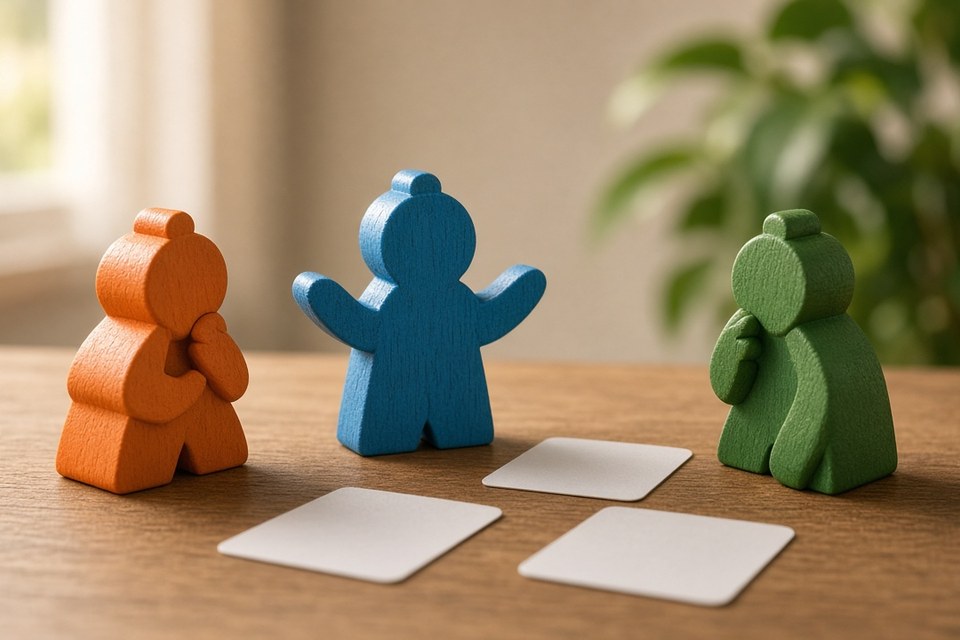
Sideways is not the same as losing, frustration, or a hard rule question. Those can stay inside the game. Sideways is when the people, not the pieces, are stuck. The picture below is illustrative, a composite, not a real group.
Two players disagree about whether a card was legal. One raises their voice. The other stops answering and looks at the table. A third player starts explaining both of them. The turn cannot move, and nobody has said what would make it fair to continue.
Repair in the moment is smaller than a debrief. You are not mining insight yet. You are getting the table clear enough to take the next turn on purpose.
1. Notice before the break hardens
| Level | What you can observe |
|---|---|
| Emerging | The host keeps explaining rules or calling the next action while voices rise, a player goes silent, or the same argument repeats. Other people see the break first. |
| Developing | The host stops, but only after a spike: a sharp line, someone standing up, or a turn that has already died. The notice is late and still useful. |
| Solid | The host marks a small shift before the next full turn: a rule stated like an accusation, a repeated sigh, a player who stops looking at the board. |
| Strong | The host names a pattern while it is still movable, including who went quiet, not only who got loud. The note is short and does not assign a motive. |
2. Pause without making someone the problem
| Level | What you can observe |
|---|---|
| Emerging | The host says "calm down" or "it is just a game," talks over the conflict, or singles one person out as the disruption. |
| Developing | The host calls a stop, but the stop sounds like a scolding, or it runs so long that the game is abandoned by accident. |
| Solid | The host holds the turn in ordinary language ("let's pause here") and lets people step away, pass, or end play without penalty. Tone stays level. |
| Strong | The pause is short and shared. The host protects the person who shut down and the person who got sharp, without crowning a winner in the first sentence. |
3. Name what happened in usable words
| Level | What you can observe |
|---|---|
| Emerging | The host labels character ("rude," "too sensitive") or explains what someone "really" meant. |
| Developing | The host describes the event, then stacks interpretation on it before anyone confirms the facts. |
| Solid | The host names what was said, what the rule question is, and whose turn it is. Then asks whether that matches what people saw. |
| Strong | The names are short enough to repeat. Game facts (the card, the turn) stay separate from how it was said. The host does not collapse them into one story. |
4. Let the people involved do the repair
| Level | What you can observe |
|---|---|
| Emerging | The host apologizes for everyone, rewrites the outcome, or tells one person the exact sentence to say. |
| Developing | The host offers a script and treats a recited line as finished, even when it sounds forced. |
| Solid | The host asks one concrete question, such as "What would make the next turn fair?" or "What needs to be said before we continue?" and waits. Both people get a chance to answer. |
| Strong | The fix comes from the table. The host holds structure (who speaks, one rule clarification, permission to pass) and still interrupts harassment and enforces boundaries. Repair language is theirs. |
5. Keep the rest of the table in the room
| Level | What you can observe |
|---|---|
| Emerging | Other players are told to stay out entirely, or they pile on while the host only manages the loudest two. |
| Developing | The host notices bystanders after someone else has already checked out or started coaching uninvited. |
| Solid | The host gives others a clear job that is not commentary ("hold advice for a minute") and a way back into the game. |
| Strong | Bystanders are part of the table, not an audience. The host blocks pile-on and does not erase them. Nobody is asked to perform a reaction. |
6. Return to play without pretending
| Level | What you can observe |
|---|---|
| Emerging | Play restarts as if nothing happened, or the game is dropped with no reason stated. |
| Developing | Play resumes, but the disputed rule or the skipped player is left messy, so the same fight returns on the next turn. |
| Solid | The host states what changes for the next turns: whose turn, which rule stands, whether a move is replayed. Then checks once: "Can we play from here?" |
| Strong | The return is specific and small. A quiet player is invited back without being put on display. The host watches the next turn to see if the repair held, and will pause again if it did not. |
How to use this for kind feedback
Do not score someone live, in front of the group. That turns a host into a judge and the table into an audience. Mark notes after, in private, and only on what you could point to.
Pick one of the six criteria. Levels are informal reflection prompts, not a validated assessment or score. Kind feedback is specific and usable. It is not vague praise, and it is not a soft way of saying someone failed.
A useful note has three parts: what you saw, what it did for the table, and one thing to try next time. Here is an illustrative note, not a real session:
"When the card argument started, you kept teaching the rule for another minute while one player went quiet. Once you paused, your words were plain and you asked both of them what would make the next turn fair. Next time, mark the quiet sooner, before you finish the rule explanation."
That is enough. Do not add a theory of why the host hesitated. You were not in their head.
If you are giving this to yourself, same rule. One criterion. One next try. Write the behavior, not a verdict about whether you are "good with conflict."
Stay inside your role. A counselor uses this inside the group's agreements, training, and license. A coach, educator, or game host is practicing hospitality and group skill, not treatment. If the moment is bigger than the game (threats, a disclosure of harm, someone who cannot stay present), stop using the rubric and follow your setting's safety plan.
Repair does not have to be elegant. A sideways game is repaired when people can take the next turn on purpose, with the break named, and without someone carrying it alone.
If you want a structured way into intentional play and better conversations, grab the free TABLE Method™ guide at playbgt.com/start.
Boundary: Board Game Therapy™ is not inherently psychotherapy. Its use depends on the facilitator, scope, setting, and purpose. Use these tools only within your training, license where applicable, and scope.