
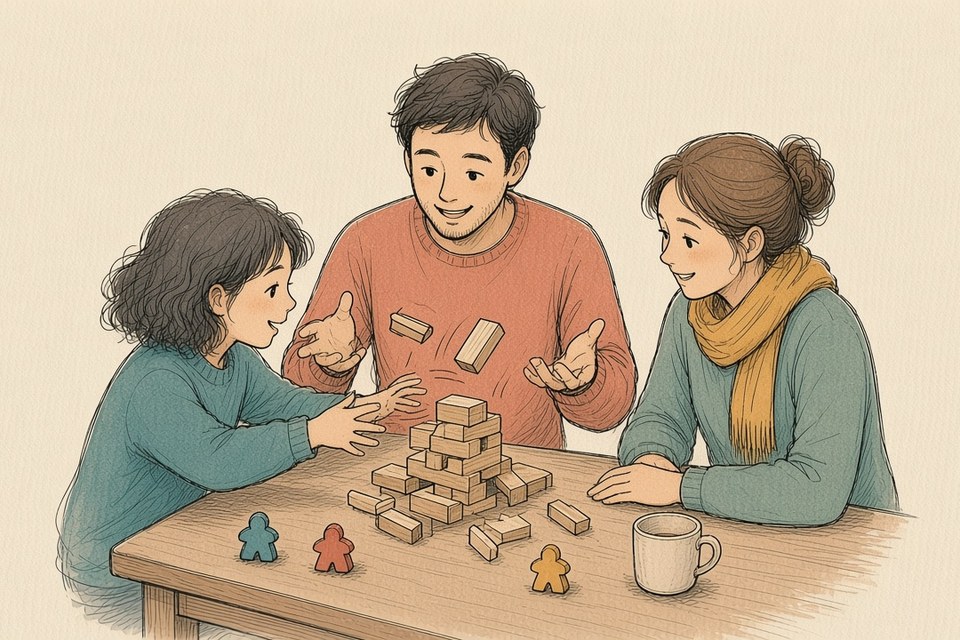
Frustration tolerance is a plain skill with a fancy name. It is what you do after something annoying happens, and before you hand that annoyance to someone else. At a game table the gap is short and public. A pull goes badly. A route closes. A tower tips. The room hears the sigh. The practice is the next ten seconds.
Used this way, Board Game Therapy™ is not inherently psychotherapy. It is structured play for noticing a skill and trying it where the stakes are cardboard, not a job or a relationship. Games can support that practice. They do not replace professional care. If someone is in crisis, stop and point them toward local emergency services or a crisis line. Counselors, coaches, educators, and hosts should stay inside their training, license, and scope. A skilled adult in the room does not turn a game into treatment.
Examples below are illustrative composites, not people from a session.
What you are actually practicing
You are not trying to erase annoyance. Annoyance is a signal. The skill is staying in the activity, naming the heat without inventing a villain, and taking a legal next action. Quitting, blaming, teasing, and shutting down are all available. The table is a place to try something else, on purpose, more than once.
Three familiar games offer three versions of the same problem. Jenga collapses in a second. Ticket to Ride closes a plan you were counting on. Pandemic lets a group feel the board getting worse when there is no opponent to blame. One game is enough.
Jenga, and the fall that was always coming
Players pull one block from a tower and place it on top. The tower grows taller and less steady. Then it falls. That ending is part of the design, not a surprise failure.
The game asks for slow hands, patience while someone else takes a long turn, and a recovery after careful work hits the table. People laugh, groan, or start a small argument about who made it wobbly. The useful rep is treating the fall as the end of a round, not a verdict on the last person who touched it.
Setup is simple. Use a steady table and a standard set. For this exercise, set aside competitive scoring and focus on rebuilding after a fall. Say the frame in a sentence or two: the fall ends the round, we rebuild if time allows, and we are watching what we do right after it tips. Two or three towers is plenty. An open-ended run stops being practice and becomes irritation.
If tremor, fatigue, or reach is in the room, use larger blocks, allow a second pair of hands, or let one person choose the block while another pulls. You are practicing the recovery, not the steadiest fingers.
Use a prompt only when it helps:
- What did you notice right before that pull?
- Round is over. A breath, or straight into the rebuild?
- No verdicts. It was going to fall.
If they are already laughing and stacking again, leave it. A question every turn becomes homework.
Ticket to Ride, and the route that is no longer yours
Players collect colored train cards and claim routes between cities. Destination tickets are usually secret. Another player can take a stretch you needed. You reroute, collect different cards, or accept a ticket you will not finish.
This frustration is slower than a falling tower. It accumulates. A color disappears. A path gets cut. The quick story is that the other person did it to you. Often they were just finishing their own line. The practice is catching that story before it runs the table.
Teach only the core loop: draw cards, claim a route, or draw tickets. Skip variants. A shorter map and a fixed clock serve this goal better than a full game that turns sour late. A timed session or face-up destination tickets are facilitator adaptations, not standard rules. If you stop before the game's normal ending, agree beforehand whether you will score the shortened game or simply debrief. Say ahead of time that blocks will happen, and that a legal claim is not automatically personal. Say the other half too. Legal is not the same as kind. If someone is targeting a player just to watch them struggle, pause. You can play a round with tickets face up so the problem is shared, then hide them once rerouting feels possible. Tell the group which version you are in.
Prompts:
- That route is gone. What is one other way across?
- Are you solving the board, or arguing with the last turn?
- You can change your route, even if the original plan no longer works. A destination ticket you kept stays with you, but you can decide how much effort to spend pursuing it.
Watch the quiet player as closely as the one who groans. Sliding cards across without looking up may mean someone needs a break. Ask, privately, what they would like.
Pandemic, when the setback has no author
Pandemic is cooperative. The group tries to hold back outbreaks while the situation escalates. A sensible turn can be followed by a card that makes the map worse. With no enemy in the room, people sometimes appoint one. They correct the last player, or they blame themselves and stop offering ideas.
The ask is to keep choosing a next action after a setback that is not a character flaw. You do not need a win. A loss that stays civil can be the whole session.
Use the base game. Four epidemic cards is a common way to set an introductory difficulty, and it is enough pressure here. Name the aim before you start: notice the heat, then make a joint decision. One suggestion at a time. Advice is offered, not issued. Agree on a pause word. If role text is too much, explain each player's ability in simpler language or provide a reference card. As an optional house rule, you may omit special abilities, but tell the group that this changes the published rules and may make the game harder.
If the disease theme is a poor fit for someone present, do not push the box. This skill does not require that setting. Stay with Jenga or Ticket to Ride, or use another cooperative game whose rules you actually know. Do not invent a gentler version and call it the published game.
Prompts:
- What is the board asking for, separate from who slipped?
- One idea, then we choose. No stacked speeches.
- We can lose this and still finish well. Losing is allowed.
Before the first piece moves
Offer a short frame in your own words. We are practicing the moment after a bad turn. A bad pull, a blocked route, or a worse board is expected. Notice it, take the next legal action, and save the larger meaning for the end. Say pause if you need one. We are not scoring who got frustrated.
Set the stop time before you open the box. Frustration gets worse when a game has no edge. Skip house rules that increase targeting. Do not tease the sigh. Do not require anyone to share. Quiet can mean someone is settling, not withholding. Ask before you interpret it.
A short debrief, then stop
Leave the board up if pointing at it helps. Three questions are enough.
- Where did the heat show up, and what did staying look like from the inside?
- What did you do in the next few seconds that you would be willing to repeat outside this room?
- What did someone else do that made the moment easier to hold, or harder?
If the group still has attention, add one transfer question: where else might a plan get blocked soon, and what is a small move before you pick a villain?
"It was just a game" is a complete answer. People do not owe you insight because you brought the box. If a closing line fits your role, keep it optional. Name one moment you stayed. Then pack up.
Fit the challenge to the people in the chairs
Younger players need a short, obvious hit. Jenga works. So does Sorry, the race game where a pawn can be bumped back toward the start. The feeling is immediate and the turn is brief. The line to practice is simple: that piece goes back, and I go again. Skip the lecture. Notice the restart.
Teens will hear a forced lesson before the first block lands. Let the annoying event happen, then ask one question. Name the difference between a legal block and poking someone to watch them unravel. They already know it. Saying it keeps the host honest.
Adults may hide inside strategy talk. They will explain an optimal line and never mention the sigh. Ask about those ten seconds. End when you said you would. A game that runs past the useful heat is just a long meeting.
Access needs are part of the design. Offer larger cards, a card holder, someone reading text aloud, one person pointing while another moves pieces, a seated reach, and permission to sit out a round. Sitting out is not failing the skill. Forcing a person through overload is not practice. If the phrase "frustration tolerance" lands badly, drop it. "What we do after a bad turn" names the same thing.
The host gets a turn at this too
You will get annoyed. A slow player, a bumped tower, a rules dispute, a cooperative game slipping out of reach. If you snap, repair in one line and go on. That came out sharp. I am resetting. Your turn. That small demonstration teaches more than a clean closing talk.
Do not choose the game most likely to embarrass someone and call the result growth. Start where a bad turn can be repaired inside a single round. The aim is that people can picture coming back, not that they endured the facilitator.
A game can support this kind of practice. It cannot show that someone handles annoyance well, or that they are ready for a harder conversation than the one you just had. Keep the claim as small as the rep. The tower fell. They helped set it back up. They took the next turn.
Everyone can pass, sit out, or stop at any time, with no explanation needed.
If you want a structured way into intentional play and better conversations, grab the free TABLE Method™ guide at playbgt.com/start.
Boundary: Board Game Therapy™ is not inherently psychotherapy. Its use depends on the facilitator, scope, setting, and purpose. Use these tools only within your training, license where applicable, and scope.