
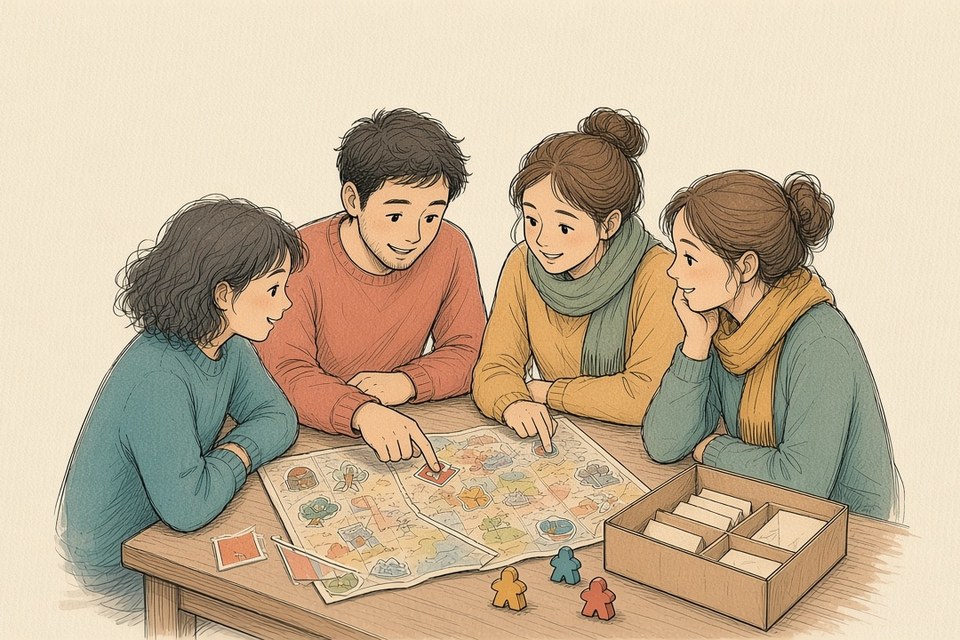
Most games forget you. You pack the board, shuffle the deck, and next week the table looks like nobody was ever there. That reset is fine for a single night of skill practice. It may be less useful for a group trying to build something over months.
Legacy games, and many campaign games, work the other way. A sticker stays. A card comes out and does not go back in. A name gets written on the map. Something unlocks or stays locked because of a group choice. The next session does not start from zero. It starts from what they actually did.
That is the part worth borrowing for a long arc. Not the theme. The object in the middle of the table can hold history the group does not have to retell from scratch.
Why a mark on the board changes the work
Ongoing groups spend real time on reconstruction. Who was here. What we agreed. Who went quiet. Notes help, and you should keep them. A changed board does something notes cannot: it sits where everyone can point. Memory is shared, not owned by the person with the best recap.
Repair can be easier when the consequence is still visible, though visible consequences can also keep blame alive. A bad call is not a foggy argument from three weeks ago. It is a city marked over, a card removed, a resource gone. The debrief can stay with the choice. What did we protect. What did we spend. What do we want next time. Nobody has to prosecute a teammate to make the point.
A missed meeting can also be easier to rejoin. Someone looks at the map and can see that the group moved. You still orient them. You do not have to rebuild the whole plot while everyone else waits.
The story stalls if people treat attendance as optional. For a closed cohort, that ask can match the real container. The game is not therapy. It is a shared object that makes "we are in this for a while" visible.
Use it for skill-building and connection: communication, frustration tolerance, negotiation, repair. It does not replace professional care. If someone is in crisis, they need local emergency services or a crisis line, not another turn. Counselors, coaches, educators, and hosts should all stay inside their training and role. This is a structured activity, not an assessment or a treatment protocol.
An illustrative composite
This example is made up. It is a composite, not a record of a real group.
A skills group for new team leads meets every other week for eight sessions. The host is a coach, not their manager. They agree up front to a legacy-style campaign, where the board changes and stays changed. Two house rules: no naming a mark after a person, and anyone can pause if a permanent change feels like a dig.
In the third session the group rushes. Jordan argues for the bold option. The table goes along. It fails. The rules require a permanent mark for the rest of the campaign.
At the fourth session, nobody reconstructs the argument from memory. The mark is on the board. The host asks three questions. What were we trying to protect. Who did not get a full say. What should this mark mean the next time a choice cannot be undone. Jordan names the rush. Someone else names staying quiet. They note, on paper not on the board, that the next irreversible choice should slow down. The mark stays. So does the agreement.
The sticker did not fix anyone. It gave the group an object to talk around.
Three practical moves
1. Contract the arc before the first permanent change.
Say how many sessions you have, what a missed meeting means, and whether the campaign ends when the group ends. Decide who keeps the box. Decide whether an absent player gets a real say before anything irreversible. If you cannot answer those, you do not have a long arc. You have a game that might strand people.
2. Separate the mark from the person.
A lost city or a scarred character gets narrated as one player's fault very quickly. Interrupt that. Debrief pace, missing information, and what the group was afraid to spend. If the game wants a name, name the event or the lesson, not a participant. Joke names do not go on components. Ink outlasts the mood that wrote it.
3. Open on the board, leave with one skill.
Start with what is different: a sticker, a tear, an unlock. Then ask one question tied to the skill in play: repair, a clear ask, or staying with a loss. Close with a short debrief that can travel outside the campaign. Insight that only lives in the box tends to stay there.
One caution
Legacy components are hard to undo. A torn card does not return. A sticker placed in anger, or as a bad joke, sits in every later meeting. Do not start this with a group still testing safety, still in open conflict, or likely to lose members before the arc ends. Consent to permanent change belongs in the first conversation.
If you need the work to be reversible, use a campaign you can reset, or a repeatable game plus your own notes. A legacy board remembers. That is the point, and the risk.
Everyone can pass, sit out, or stop at any time, with no explanation needed.
If you want a structured way into intentional play and better conversations, grab the free TABLE Method™ guide at playbgt.com/start.
Boundary: Board Game Therapy™ is not inherently psychotherapy. Its use depends on the facilitator, scope, setting, and purpose. Use these tools only within your training, license where applicable, and scope.