
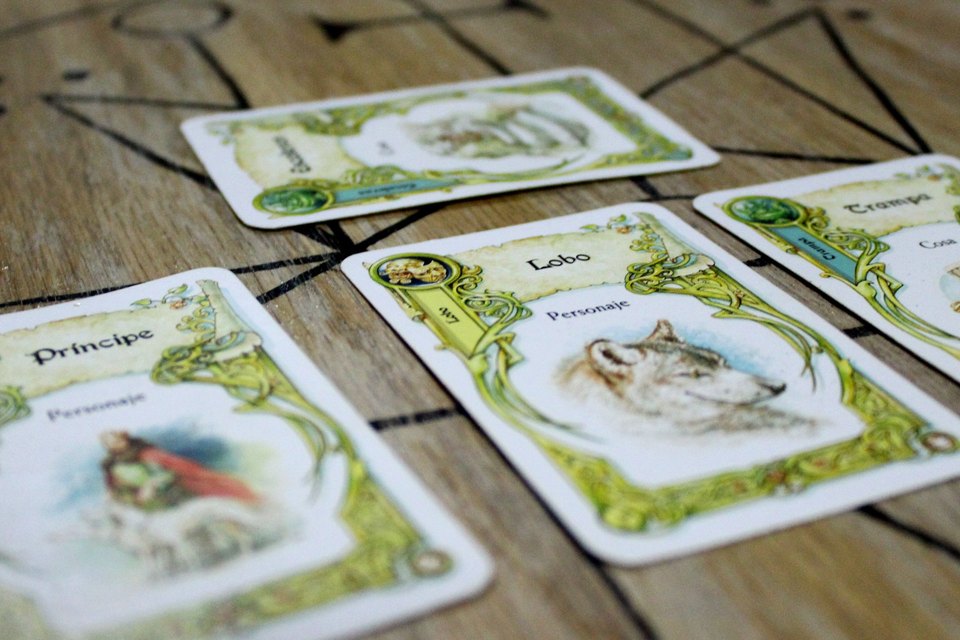
Describing a problem is one thing. Finding words for what it feels like from the inside can be harder, especially in a room where someone is still deciding how much of themselves to show. Storytelling games give that second kind of speech a shape. A card, a picture, a shared map, or a character becomes the thing you talk through. You get to try a sentence before you have to own it as a fact about your life.
That is the useful part for counselors, coaches, educators, and game hosts. Not the plot. The practice of putting language on something inner, in front of other people, with permission to keep it fictional.
What storytelling games ask for
A storytelling game is any game whose main action is making meaning together out loud. Sometimes that is a long scene. Sometimes it is one clue on a picture. In Dixit, you offer a phrase for an illustrated card and hope some people catch your meaning while others miss it. In Once Upon a Time, you build a fairy tale from cards in your hand and try to land on an ending you were holding from the start. In a tabletop roleplaying game like Dungeons and Dragons, a group speaks as characters inside a situation the table agreed to imagine.
The mechanics differ. The social ask is similar. You take a turn. You add something other people can answer. You live with the version that comes back, which is rarely the version in your head.
That last part is the practice. Self-expression here is not a monologue. It is an offer. If you only wanted to be heard exactly, a journal would be kinder. The game asks for something harder: a sentence clear enough that someone else can pick it up.
Expression is not disclosure
A common mistake is to treat every vivid story as a confession. It is not. A player can put fear in a character because fear is interesting, because the prompt nudged that way, or because they liked a film with that mood. They can also put fear there because it is close to home and the character is a safer mouth. You will not know which from the fiction alone. You should not try to.
This is where these games earn their keep in skill-building work. They let someone practice the shape of an experience without turning the table into an intake. The examples that follow are illustrative composites, not case reports.
A teen in a classroom can describe a leader who will not listen, through a made-up captain, and work on how to say "I need a turn" without narrating their actual family. A team in a coaching session can give a project a weather report, foggy, with one clear path nobody trusts yet, and find they already had language for the stuckness. An adult in counseling, inside a scope you are trained for, might notice they gave a character a boundary they have not tried in life. That can be material for work you are already doing with them. It is not evidence you mined from a game.
If someone is in crisis, a storytelling game is the wrong container. Pause the play. Help them reach local emergency services or a crisis line. Games can support reflection and connection. They do not replace professional care, and they are not a place to hold acute risk.
The skills hiding in a turn
Watch what people do between "your turn" and the end of the sentence. A few skills show up whether the table is playful or serious.
Choosing a level of exposure. A good prompt can be answered lightly or nearer to the bone. The skill is noticing that choice and making it on purpose. People share at all different levels. The game offers a range of options.
Finding a concrete image. "I feel overwhelmed" is hard to work with. "The character is holding six maps and none of them match the road" gives the room something to touch. Prompts pull people toward objects, weather, gestures, and dialogue. That is language practice, not decoration.
Letting the story change. You offer a detail. Someone builds on it in a direction you did not pick. You can fight for your version, fold, or revise out loud. Done cleanly, those are assertiveness, flexibility, and repair.
Finishing. A lot of self-expression dies in a hedge. Story games often force an ending: a last card, a closing line, a scene that has to stop so the next player can move. A small, complete thought can be satisfying to say.
Listening for the offer, not the autobiography. Someone hands you a fisherman who lies to his crew. In the game, your job is to respond to the fisherman. Later, as a facilitator, you might ask what it was like to play him. Those are different jobs. Mixing them in the moment teaches people that their play will be analyzed. The play gets cautious.
How not to over-read the fiction
Facilitators get curious. Curiosity is fine. Interpretation delivered as fact is not.
"You made the queen cruel because you are angry at your mother" is a claim you cannot support from a card. Even if you were right, saying it that way takes the story away from the person who told it. They stop being the author. They become the subject.
Better questions stay with craft and choice.
- What made you pick that detail?
- Was there a version you almost said and did not?
- Where did the story get easier, and where did you have to push?
- If you played it again, what would you change on purpose?
Those questions treat the player as someone with agency. They also leave room for "I just liked the picture." That answer should be allowed to stand. If every light response gets dug up for a deeper one, people learn that lightness is not safe here. Then you lose the range that made the game useful.
Stay inside your training, your license, and your role. A teacher can help a student notice how they entered a scene. A coach can connect a metaphor to a goal the client already named. A licensed clinician can decide, with the client, whether a theme belongs in the work. A host at a public table should mostly stay with the play: what was fun, what was hard, what the group wants next time. None of these roles needs to turn a story into a verdict.
Board Game Therapy™, used this way, is skill-building and connection. It is not inherently psychotherapy just because feelings showed up. If you are not the person's clinician, do not slide into that seat because the fiction got tender.
Hosting so the door stays open
Name the frame before the first card. Say that stories can be invented, borrowed, or personal, and that nobody has to explain which. Say that passing is a full turn. People trust the rule they hear before they are already in a scene more than the one you offer after they have gone too far.
Pick prompts with a wide floor. The best early prompts can be a joke, a memory, or pure invention. "Describe a door your character will not open" can be a goblin door, a messy closet, or something heavier. "Tell us a time you were abandoned" cannot. Start with the first kind. Let depth be something people walk toward, not a trap under the lightest card.
Watch for the warm-room spill. A kind table can pull more disclosure than the person meant to give. Warmth is not consent. If someone starts narrating a real crisis, a real trauma, or someone else's private life, thank them, slow the table, and offer a narrower question: want to keep that in the fiction, or pause and talk about what you need right now? Then follow their answer. Do not collect the story for the group's benefit.
Debrief the player, not the character's secret. For an ordinary play session, a brief debrief of about ten minutes may be enough. If someone needs more support, respond according to your role, setting, and applicable safety procedures. Ask what they noticed about their own choices, and whether there is one plain sentence they might use in ordinary speech this week. Write nothing down unless your setting already has a clear, consented reason to write things down. A note the client asked for is different from a host's private theory about someone's childhood.
End while the story is still a story. Pack the cards. Say the fiction can stay on the table. For people who just said something true-adjacent in front of peers, that is the difference between practice and exposure.
Try this
Use this with almost any storytelling game, or with blank cards if the shelf is empty. It runs in about twenty minutes with three to six people. Tell the group these are made-up answers unless someone chooses otherwise.
- Give each person one constraint. A picture card, a single word, or the start of a sentence: "The character keeps a small object in their pocket because..."
- Each person adds one or two sentences. No follow-up questions during the round. Passing is allowed and does not need a reason.
- After the round, one shared beat. Each person may add a single line that responds to someone else's detail, or they may pass again.
- Close with three questions, answered only by whoever wants to speak. What was easy to invent? What did you almost say? Is there one plain sentence from tonight you might use in real life, with the fiction stripped off?
- Stop. Do not interpret. Thank people for the offer, not for the revelation.
If the group is new, keep the constraint silly on purpose. A cursed sandwich. A map that only works indoors. Humor is not necessarily avoidance. It can be a way to learn the mechanic before the content gets close. In a clinical setting, use this only when it fits the plan and your competence. At a public table, treat step 4 as optional and keep step 5 firm.
The point is not a better plot, and not a clever reading of someone else's pain. It is a rep. Someone practices putting an experience, imagined or personal, into words, in company, at a distance they chose. They hear themselves finish the thought. Then they set the story down and walk out still in charge of what it meant.
That is self-expression with a handle on it. You can pick it up next time. You do not have to carry it home in your teeth.
If you want a structured way into intentional play and better conversations, grab the free TABLE Method™ guide at playbgt.com/start.
Boundary: Board Game Therapy™ is not inherently psychotherapy. Its use depends on the facilitator, scope, setting, and purpose. Use these tools only within your training, license where applicable, and scope.