
Home / Articles / Adapting Board Games for Accessibility: Keep the Choice, Change the Barrier
Access
Adapting Board Games for Accessibility: Keep the Choice, Change the Barrier
By Sean M. Smith · November 4, 2026 · 7 min read
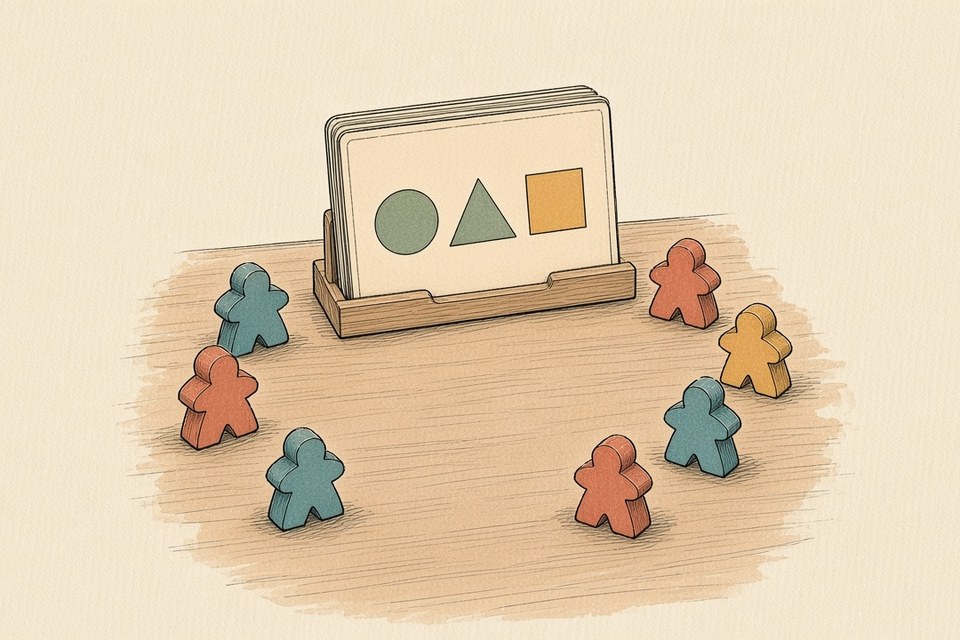
To adapt a board game for accessibility, change what blocks a player, such as reading, holding, seeing, or timing, while keeping their decision intact. Label every change as a facilitator adaptation, separate from the published rules.
The practical question is simple: can everyone take a meaningful turn? Start there, ask the player what would help, and try the smallest useful change. You do not need someone's diagnosis to make the table usable.
What to change and what to keep
Before adapting board games for accessibility, write one sentence about the choice you want to preserve. Perhaps players are choosing a clue, weighing an offer, or deciding how to use limited information. That sentence gives you a way to judge a proposed change.
Then separate the decision from its delivery. Holding cards, reading small print, reaching the center, and following overlapping voices can demand effort without adding an interesting choice. A card stand or quieter room may address the barrier before you change any rule.
Avoid assuming that easier is always better. Someone may want the same difficult decision with readable information. Someone else may prefer fewer demands today. Ask which part is getting in the way, and let the answer guide the adjustment.
Codenames: make the grid usable
Codenames has two teams and a grid of 25 word cards. Each team's spymaster gives a clue of one word and one number; the number says how many words the clue relates to. The clue cannot be a word visible on the table or any form of one, such as break while BREAK is still uncovered.
An enlarged or high-contrast reference of the same public grid is a facilitator adaptation. Agree how it stays in sync as cards get covered. The spymaster's key card stays private. Ask whether the format helps; enlargement alone may not solve the barrier.
Just One and Azul: preserve control and information
Just One is cooperative. Everyone except the active player secretly writes a one-word clue on their easel. The active player closes their eyes while identical or invalid clues are cancelled, then gets one guess or may pass.
A larger writing surface or a typed clue on a phone or tablet held like the easel is a facilitator adaptation. Keep clues hidden from the guesser before cancellation. Reading surviving clues aloud after cancellation for a guesser who needs audio is also a facilitator adaptation.
In Azul, on your turn, take all tiles of one color from one Factory display, moving the rest to the center, or all tiles of one color from the center. Then place them in one legal pattern line on your board; any tiles you cannot or choose not to place there go to your floor line.
Facilitator adaptations include a caller who picks up and places tiles only at the player's direction, Factory displays placed within reach or rotated, descriptions of tile colors and patterns aloud on request, and color labels or symbols on a reference card for players who need color access. If assistance becomes advice, return the decision to the player.
Ask the player first
Offer an access question to everyone before setup: what about text, color, reach, sound, pace, or holding pieces could make play difficult today? Allow a private answer or a pass. People should not have to explain medical histories to get a turn.
If someone tells you privately that reaching is difficult, bring the category to the group without retelling the story. Explain where components will sit and how movement requests will work. Do not announce who prompted the change unless that person wants you to.
Offer one or two options, then listen. A player can accept, revise, or refuse your suggestion. Your first idea is a guess, and their refusal is useful information.
Make the adaptation ordinary
Where practical, make the option available to anyone. A visible reference card, a reader on request, or a shared pause agreement can become part of how the table runs. Avoid repeatedly thanking a player for using an accommodation or reminding everyone why it exists.
Illustrative composite: Morgan wants to make their own decisions but cannot comfortably reach the center. The host offers a caller arrangement to everyone. Morgan directs each movement and asks for no strategic advice. The example shows a procedure, not an observed outcome.
Shared options still need consent. Pairing players can help with handling while also making it easier for one person to take over. Ask whether the arrangement leaves each player with the choices they wanted.
Put it into practice: a facilitator plan
Use a game you already know how to teach. Reduce glare, check table reach, and notice background noise before the group arrives. Learning an unfamiliar game and redesigning it at the same time makes it harder to see what your change affects.
Use the TABLE Method™ to shape the session. Shape the encounter, not the person.
- Target: What is this table meant to practice, reveal, or make possible? Name the meaningful decision to preserve, such as choosing a clue independently.
- Assess: What can this table safely and productively handle right now? Ask about text, reach, sound, and pace without requiring disclosure of a diagnosis.
- Build: What conditions will create the right kind of opportunity? Prepare the access options with the player. Use the checklist below to record what changes and what stays.
- Lead: How do I participate from within the game while tracking the human system? Try a short slice of play and check whether assistance leaves decisions with the player. Use the checklist to adjust or stop.
- Extract and Extend: What happened, what did it mean, and what is worth carrying beyond the table? Ask what helped participation and what should change next time. Allow a pass; nobody needs to explain a personal history.
Use this access checklist during Build and Lead, then decide what to retain during Extract and Extend:
- Name the decision you want to keep and the barrier you want to address.
- Ask what would help. Offer two options at most, with room to refuse both.
- Write a facilitator adaptation card: what stays, what changes, who can use it, and what would show it is failing.
- Try a short slice of play. Explain the adaptation when it matters, then let people play.
- Check once: helping, in the way, or fine? Change course sooner if someone cannot participate.
- Ask whether the card stays for this group or ends today.
Keep notes about the procedure rather than treating players' struggles as assessment data. Follow any documentation requirements your setting already has.
When the first change fails
An adaptation fails when someone still cannot take a meaningful turn or when it removes the choice the group meant to preserve. Adjust the procedure rather than defending your idea.
If a helper starts deciding, return control to the player. If a reference still cannot be read, ask about a different format. If the room remains too noisy, changing the room may matter more than changing the game.
Switch games when needed. An honest change of box is preferable to repeated experiments that leave someone watching. Follow existing accommodation processes in your setting; a house adaptation does not replace them.
FAQ
Do I need a diagnosis before offering an adaptation?
No diagnosis is needed to ask what blocks a turn. For an ordinary game night, focus on the practical request. Follow formal accommodation processes where your setting requires them without asking players to disclose private information to peers.
Is changing a procedure unfair?
Ask what meaningful choice remains available to each player. Explain the facilitator adaptation before play, invite concerns about its effects, and revise it if it creates another barrier. Identical physical demands do not automatically produce usable turns.
What if the player dislikes my suggestion?
Let them refuse it. Ask what would work better, offer a smaller change, or choose another game. Participation does not require accepting your preferred solution.
Scope and evidence
Host: Belonging and connection first. No diagnosis. No treatment claims. Stop when the material exceeds your role.
Coach: Nonclinical skill development. Stay developmental. Do not frame this as psychotherapy. No diagnosis. No treatment claims.
Therapist: Licensed clinicians may use structured play as an adjunct inside an existing treatment relationship. Consent, judgment, and documentation stay with you. Not a stand-alone therapy product and not a diagnosis tool.
Boundary: Board Game Therapy™ is not inherently psychotherapy. Its use depends on the facilitator, scope, setting, and purpose. Use these tools only within your training, license where applicable, and scope.
At its core, Board Game Therapy™ is structured play, not therapy. Play can be therapeutic, and licensed clinicians may use it inside an existing treatment relationship, but it does not replace professional care. If someone is in crisis, stop play and follow your setting's safety plan, including local emergency services or a crisis line.
A house adaptation does not replace a formal accommodation process.
Evidence: practice-derived; BGT-specific outcomes still need formal evaluation.