
Home / Articles / Say the Ask Out Loud: Negotiation Board Games for Assertiveness Practice
Communication
Say the Ask Out Loud: Negotiation Board Games for Assertiveness Practice
By Sean M. Smith · November 4, 2026 · 7 min read
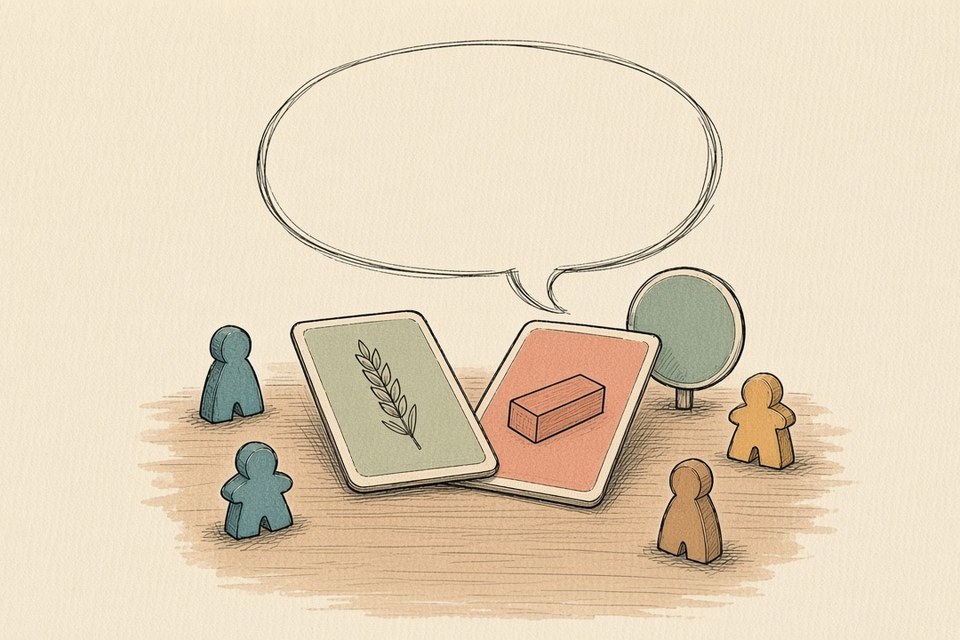
Negotiation board games offer a setting for practicing a clear request, a concrete offer, and a response that respects no. Choose a familiar game, agree on the practice frame, and keep the focus on what players say rather than who wins a trade.
Assertiveness here is a small, observable sequence. Name what you want. Leave room for the other person's answer. Respond without hiding your request or pressuring them to change their mind. A declined trade can still contain all three moves.
Catan and Bohnanza: one ask at a time
In Catan, on your turn after the production roll, you may trade resource cards with other players. Announce what you need and what you will give; other players may counteroffer. While it is your turn, you must be part of every trade, and other players may not trade among themselves. You cannot give cards away.
In Bohnanza's trading phase, only the active player trades with the other players; they cannot trade with each other. Trades need both players to agree. Cards may also be given as gifts, but the receiver must agree to take them and can refuse.
Both games route every trade through the active player, making one ask at a time natural. Both let a player say no. Catan's announcement mirrors an ask plus offer; Bohnanza's gift rule shows that even generosity needs a yes. Choose a game the group knows so learning it does not crowd out sentence practice.
Sheriff of Nottingham: a higher pressure option
In Sheriff of Nottingham, each round one player is the Sheriff. Merchants declare the exact number of goods in their bag and one type of legal good; they may lie about the type. The Sheriff decides which bags to inspect. Merchants may offer bribes, including promises of future favors, which are allowed but not binding. The Sheriff may accept a bribe and let the bag pass unopened, or reject the offered bribe and inspect the bag.
This higher pressure option features bluffing and bribe negotiation. Reserve it for groups already comfortable with bluffing to practice holding a position under pressure and saying no to an offer. Be ready to pause. Start with Catan, Bohnanza, or the card exercise when a straightforward exchange fits better.
The three moves of a clear exchange
First, make the request specific enough to answer. Name the item or action, and include amount or timing where it matters. In a standalone practice exercise, a participant might ask for one Help card rather than hinting that their task looks difficult.
Second, state the offer. The listener needs to know what they would receive and when. If you are asking a favor rather than proposing a trade, say so.
Third, pause for the answer. A yes, a no, or a different offer can each be a real reply. A firm no does not invite another attempt. Ask about alternatives only when the listener is willing to continue.
Hearing no without taking it personally
The right to refuse makes the exchange meaningful. If the listener must agree to keep the room comfortable, the asker is practicing pressure rather than leaving room for an answer.
A clean stop can be brief: okay, thanks. If both people want to continue, a revision should change the offer or timing. Repeating the same request more loudly, adding guilt, or making a joke at the listener's expense does not create a new offer.
Illustrative composite: Priya requests a Help card and offers a Time card in the standalone exercise. Chris declines. Priya asks whether Chris wants to hear a different offer. Chris says no, and Priya stops. No card changes hands. The example shows respect for an answer, not an observed result.
Do not reward agreement over refusal. Both roles are practicing: one person makes an answerable request, and the other gives an answer they are allowed to mean.
Put it into practice: a facilitator plan
Use the TABLE Method™ to shape the session. Shape the encounter, not the person.
- Target: What is this table meant to practice, reveal, or make possible? Choose one narrow goal: a specific request followed by room for an answer.
- Assess: What can this table safely and productively handle right now? Check comfort with refusal and pressure. Avoid requiring requests directed at someone with authority over the participant.
- Build: What conditions will create the right kind of opportunity? Offer passing, writing, or observing. Prepare the facilitator-designed card exercise below if a familiar game is unavailable.
- Lead: How do I participate from within the game while tracking the human system? Participate while listening for clear asks and freely given answers. Pause pressure and return choices to the speaker.
- Extract and Extend: What happened, what did it mean, and what is worth carrying beyond the table? Ask what made a request answerable and whether the reply was respected. Invite one optional practice sentence for outside play, without requiring disclosure or follow-through.
If the group does not know a suitable published game, use index cards labeled Time, Help, A Turn, Information, and A Favor. Use this facilitator-designed standalone exercise during Build and Lead; it is not a published game:
- Give each person two resource cards and a prepared private need, such as finishing with a Time card. Use fictional needs so personal disclosure is unnecessary.
- Before cards move, the asker names the request and concrete offer. The listener may refuse. Nobody takes a card from another hand.
- Allow up to three trade attempts per person, then end the round. A firm no ends that exchange; attempts are not permission to pursue the same person.
- Offer the stems “I need ___” and “I can offer ___” if someone wants help. A pass stands.
- Pause once to demonstrate a clearer sentence using changed details so no participant becomes the example.
- Close with a short debrief, whether or not anyone met their card need.
The sentence prompts “I need ___” and “I can offer ___” are facilitator adaptations when used in published games. Keep the exchange within that game's rules.
When the loudest voice takes over
State the asker's opportunity to speak before play starts. If another participant rewrites a quiet player's request, ask whether help was wanted. Return the choice to the original speaker, including the choice to use writing or pass.
Pair work can reduce the number of competing voices. An observer, if used, reports only the ask and offer they heard; they do not improve the deal. These are facilitator adaptations to the practice format, not claims about published game procedures.
If losing a resource feels too costly today, remove scarcity from the exercise or skip the exchange and rehearse sentences. If tension becomes personal, pause. Finishing the round is less important than keeping refusal meaningful.
Debrief the sentence, not the person
Ask two or three questions: what made the request answerable? What did the listener actually hear? Did the next sentence respect the reply? Allow spoken answers, written answers, or a pass.
Do not rank who was most assertive. Notice clarity and boundaries without treating confidence, volume, or a successful deal as the score.
FAQ
Does a successful trade show assertiveness?
A deal alone tells you little about the communication. Look for a specific request, an answer the listener could freely give, and a response that respects that answer. Refusal can end a clear exchange.
Can players revise an offer after no?
Only if the listener is willing to continue and the game's rules allow the proposed exchange. A firm no ends the pressure. A revision changes the offer or timing rather than repeating the demand.
What if someone does not want to speak?
Offer writing, a peer pair, observation, or a pass. Do not turn the practice into a public test. Ask which format the participant wants rather than choosing a helper for them.
Scope and evidence
Host: Belonging and connection first. No diagnosis. No treatment claims. Stop when the material exceeds your role.
Coach: Nonclinical skill development. Stay developmental. Do not frame this as psychotherapy. No diagnosis. No treatment claims.
Therapist: Licensed clinicians may use structured play as an adjunct inside an existing treatment relationship. Consent, judgment, and documentation stay with you. Not a stand-alone therapy product and not a diagnosis tool.
Boundary: Board Game Therapy™ is not inherently psychotherapy. Its use depends on the facilitator, scope, setting, and purpose. Use these tools only within your training, license where applicable, and scope.
At its core, Board Game Therapy™ is structured play, not therapy. Play can be therapeutic, and licensed clinicians may use it inside an existing treatment relationship, but it does not replace professional care. If someone is in crisis, stop play and follow your setting's safety plan, including local emergency services or a crisis line.
Evidence: practice-derived; BGT-specific outcomes still need formal evaluation.
Topic: Communication
Games to try / Keep reading
Games to try
- Catan: Every trade runs through the active player
- Sheriff of Nottingham: Holding a position under pressure
- Bohnanza: Trades and gifts both need a yes (no guide yet)